Bronze (as seen in The Odyssey)
Nolan’s recent retelling of The Odyssey has sparked a lot of conversations about history and politics and literature, but The Odyssey is also a story about materials. A horse is made of wood, a statue of marble, and a sword of bronze. Homer’s poem comes from an era we now name after this last material: the Bronze Age. So what is bronze, and why was it so important?
Bronze is a metal made of roughly seven parts copper to one part tin. This combination (“alloy”) of metals gives bronze some of the characteristics of each, hitting a sweet spot of hardness and softness. Hardness is important because it means that you can sharpen a bronze blade so that it holds its edge; softness is important because it means you can make a bronze blade in the first place. Copper gives bronze its warm colour and hardness. Tin softens hot bronze, making it easier to work into a sword or a spearhead. It also makes cold bronze harder than pure copper, as the mixture of small copper and large tin atoms cannot easily slide past each other.
This has always meant that trade is important for bronze production, because the natural variation in the composition of metals from different mines was an important way of controlling the composition of the alloy. Buying quality goods without seeing them has always been hard, and the first letter of complaint we know of was a Bronze Age cuneiform tablet complaining about the quality of copper bought through a middleman. Nolan’s presentation of the material motivation for invading Troy – Agamemnon’s trade ambitions – is consistent with the archaeological record on this point. By analysing the exact composition of bronze artifacts (normally by looking for trace elements like cobalt), we can confidently claim that copper often travelled many hundreds of miles before being made into bronze.
This hard-enough-but-soft-enough metal let civilisations access new technologies, even in the narrow (and occasionally anachronistic) focus of Nolan’s film. Bronze gongs sounded the alarm as Troy was sacked. Bronze helmets protected soldiers’ heads, and bronze-tipped spears punctured leather armour without using too much of the expensive and heavy metal. Bronze is often seen in decorative contexts now that the world has so much steel, but when Troy fell bronze was functional. Its function was hardness.
Bronze’s continued popularity in sculpture is part of the same story: we can make this hard metal into the shapes we want. Rodin’s The Thinker – an incredibly recognisable cultural artefact – is made of it. Later developments in copper alloys like brass, which involves combining copper with zinc to make an even harder metal, opened up an important space for mechanical components. A brass cog wheel is an object which embodies an answer to the same question as a bronze sword: what shapes do I wish this metal to take? The dramatic shift of the Bronze Age was that a hard metal became subject to human imagination.
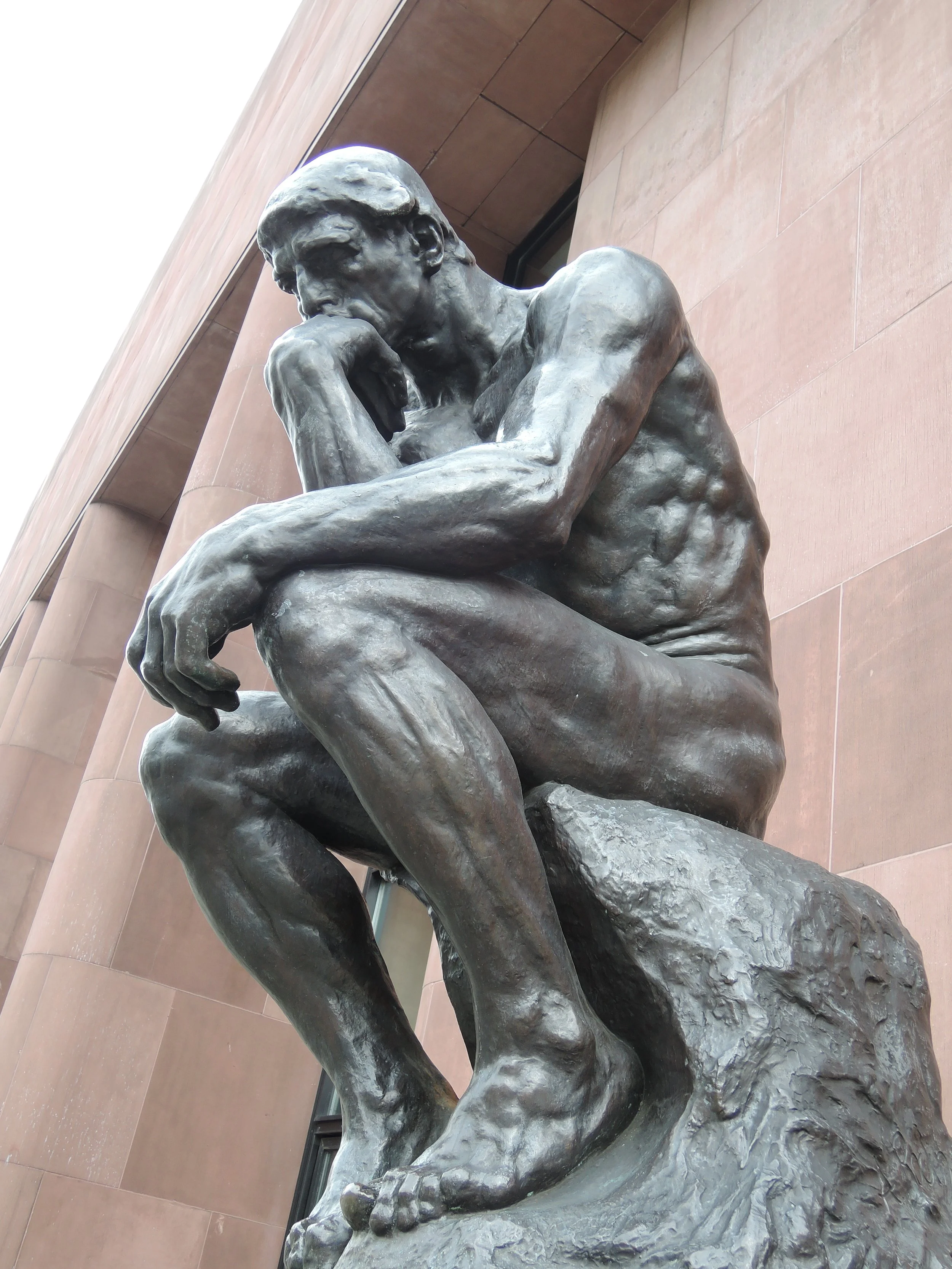
Rodin’s sculpture The Thinker (Le Penseur)
Soft metals, of course, were already subject to the imagination. Nolan’s presentation of Penelope’s pin is an example of this. Gold – a very soft metal – is much easier to shape than bronze, and decorative gold work is relatively easy to do at room temperature (if you have artistic skill). But a gold knife would be ridiculous, shaping itself against whatever it was used to cut and swiftly becoming blunt. There are limits to gold’s usefulness as a hard material, even if its cultural role as a soft metal remains extraordinarily important to this day.
Harder metals took longer to become subject to human imagination. When the Lystrigonians’ steel armour deflects the bronze swords of Odysseus’ men, the crew are forced to retreat. Odysseus’ sharp cunning and bronze’s sharp edges were both inadequate to overcome an alloy of iron. It is interesting that Nolan shows one of Odysseus’ setbacks as being specifically technological. After thousands of years, this is an interesting way to put an ancient poem to new uses.
Bronze, too, still finds new uses – even if they likely aren’t the uses Odysseus would have put it to. It’s common to see bronze used in high-corrosion applications like marine engineering, for example. Weird properties of the metal like the way it doesn’t spark when you strike it against another metal make it the perfect material to use for the tools used in ignition-risk settings like an oil rig.
And even if these uses for bronze aren’t as civilisation-defining as they used to be, bronze remains completely critical to our historical trajectory just as it remains a central part of our modern understanding of alloys. It’s still worth thinking about Odysseus, and it’s still worth thinking about bronze.