Beyond Access? Class in Chemistry
The RSC recently published a report on socioeconomic background in Chemistry. The report’s central concern is to set out how some of the structural barriers experienced by students with low socioeconomic status. Its recommendations are broadly about addressing socioeconomic-adjacent barriers to accessing and succeeding in undergraduate chemistry degrees.
I’ve been reflecting on it for a few weeks, and despite many of the report’s claims being constructed on the narrow basis of socioeconomic status I have been using it to think about the wider idea of Class. Any discussion of Class in HE leaves me with a lot of questions. Perhaps these are useful to hold out honestly, in case there is someone out there who can answer them. Ricocheting from Cambridge to Hull to Oxford to Liverpool forces you to think some thoughts about Class in Britain, though I recognise that I am tethered by my own middle-class childhood.
Part of the reason Class isn’t a protected characteristic in the Equality Act is that it’s hard to define. Is it about the economics of earning (or family earning)? Something about the social standing of certain types of employment (or parents’ employment)? Or is it a part of identity which is claimed subjectively? A spectre haunting the whole document is that data like the respondent quotes are likely drawn from very different perspectives on this question, despite the quantitative work being built out of a certain view of what “socioeconomic background” is. For example, the two quotes below are both on p24; one is about Class as a social phenomenon, the other about money as an economic context for study.
“The way you dress, the way you speak, even the references you get – all these things signal your background and affect how people treat you.”
Focus group participant, England
Financial constraints meant balancing part-time work with studies, limiting access to extracurricular opportunities. However, these experiences fostered resilience, time management and determination.”
Woman, 25-29, lower SEB, White, England
Access as Equality of Opportunity
There is some meaningful sense in which access to a University places you in the same position as others who are there. Every first year student has a shot at getting a Chemistry degree simply because they are a first year Chemistry student. It’s also true that the odds of making the shot are not the same for everyone. The report explains how people describe it as being harder if you’re poor and harder if you don’t feel like you fit in.
There is an operational ambiguity about the goal in this context, which I’ve never properly resolved in my own head. Which opportunity are we thinking about equalising, exactly? Getting a shot at a degree is about access (who is there on Day 1). Finishing a degree is about support to meet a threshold (what 40% means, say). Getting a first-class degree is about support to meet a ceiling (perhaps what 70% means). But picking one of these might damage the others. Giving lots of poor students a shot at first year will likely damage progress against the proportion of poor students getting a first, for example. Is it good to take on a lot of people who are likely to fail? Probably not. Is it good to take on only those who are most likely to get the highest grades? Probably not.
The compounding of privilege is a key mechanism in the flow of learners from school to University. Discrimination on prior attainment is a normal thing for Universities to do (the “entry tariff”), and this necessarily discriminates indirectly against Class in the current composition of British education because grades relate closely to children’s experiences of going to school. There are ways of softening this effect - York is one institution with a proud tradition of rigorous contextual admissions policies - but academic barriers to academic study are seen as completely appropriate, especially for a subject which you can study at A Level.
The massive growth in online tutoring services has complicated this picture further, making it much easier to spend money to polish a child’s education without leaping to the level of private school fees. The oddly-local composition of secondary education also means that certain areas of the country have free Grammar Schools. I was surprised to see so little discussion of secondary education in the report’s recommendations, given how important it was in the analysis. The specific role that the Chemistry A Level serves as a passport to Medicine degrees is also an extremely important piece of this picture, because it requires aggressive discrimination of top performances and also constructs a highly-legible professional trajectory out of Chemistry for high-achieving chemistry pupils.
And the compounding continues beyond Universities, too. If you are getting 500 applications for each job, how do you whittle down the number so you are considering some realistic quantity? By grade? By whether an applicant went to the Russell Group? To Oxbridge? These are questions relating closely to Class, and a modern version of this old problem is that these biases are woven through the training set data. Many of the AI tools which might be used to whittle down a list of applicants for consideration will have prejudice against certain people baked into a neutral-looking program.
University as a Transformational Space
While they are undoubtedly problematic, barriers within Universities are often completely appropriate as well: someone who has performed badly in a first year module should fail it. The work of study is often about becoming better at a subject so that you reach a level of understanding you didn’t have before, even if this is harder for some people than for others. If a degree certifies that you have a working knowledge of organic mechanisms, the question is about whether you have that knowledge rather than whether it was hard to develop that knowledge.
So what do you do when some people are unable to reach that level because of money? When the student doing 20h of bar work each week doesn’t do well in their exam? I’ve seen some institutions refuse to budge, acknowledging that financially-poor students will become more likely to fail. I’ve seen other places lower their standards, so everyone is more likely to pass. Neither of these seems great to me, but they do both show an unflinching acceptance of reality. There are more hopeful visions where you try to reimagine a course to be difficult in ways which don’t relate so closely to money, but these are incredibly difficult to build if you tacitly demand a certain breadth and depth of knowledge (which, for Problem Solving, we normally do).
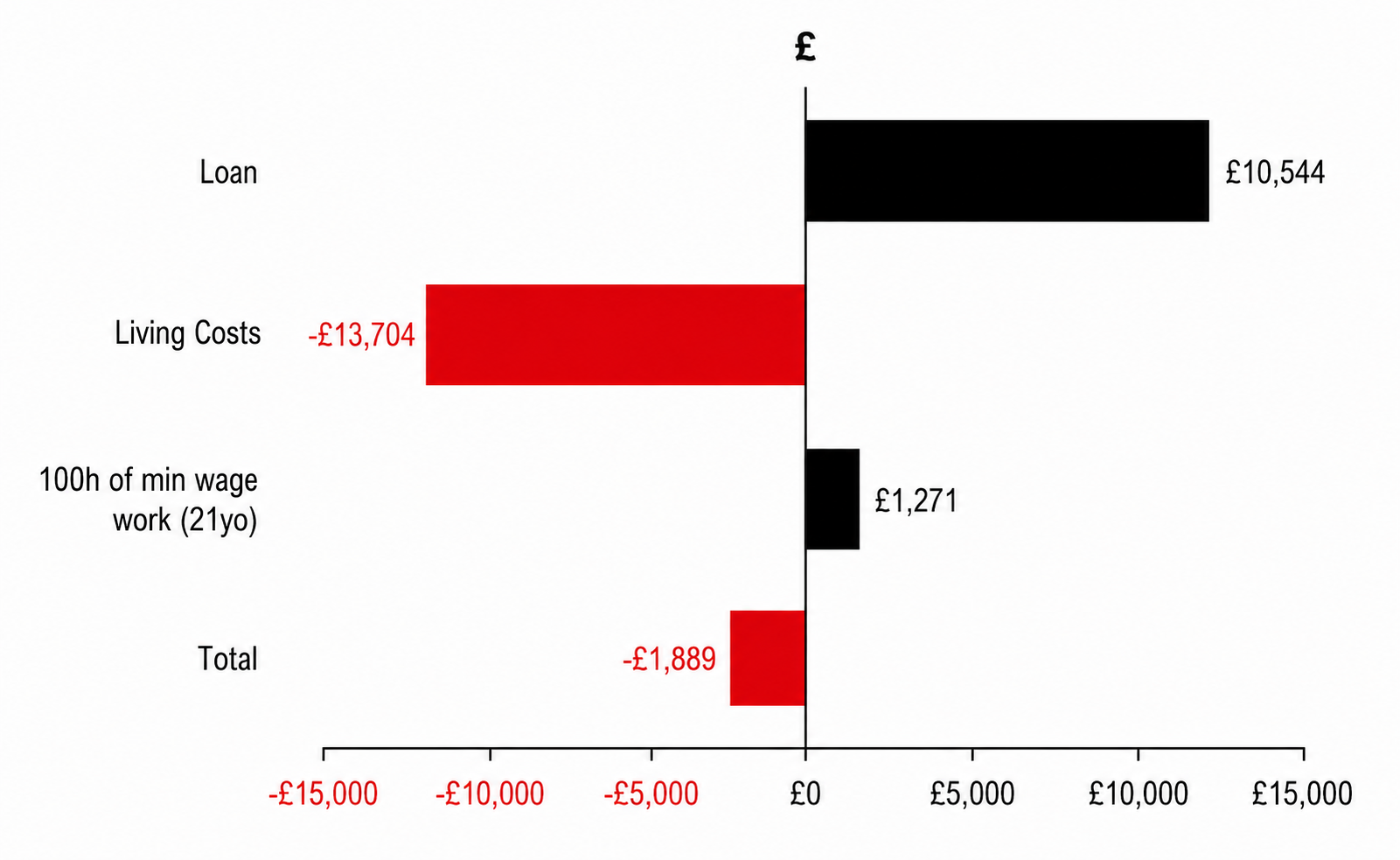
A representative account of 2026 finances for a UK home student in 2026. Living cost data from Save the Student. The maintenance loan does not cover living costs, and the gap between the two numbers is pretty substantial. The 100h of minimum wage work is intended to give a rough sense of students’ earning power, but does not consider deductions (National Insurance, Tax). One-off payments like housing deposits - often near the start of the year - make the whole-year numbers difficult to break down to a monthly analysis.
University isn’t just about academic change, either. A rounded BSc experience should involve the difficult and joyful process of meeting people from different backgrounds. This involves our identities and taste in ways which link very closely to Class, and this certainly can extend to finances as well. (Can you afford to go clubbing after labs on Thursday? Can you afford to go to a friend’s birthday meal?) A substantial part of this is about student-student interactions, in ways which might not be fully considered by employees in a University. How do you relate to someone telling you about their skiing holiday as they set up their reflux apparatus next to you after Christmas? The first time it happens to you in the flow of a conversation it can be hard to know how to respond, but one part of an education is learning how to get along with your lab partner.
Belonging: Class as Social or Economic?
That question of belonging is one of the core themes of the report, but probably also the one where the ambiguity between Class and socioeconomic background makes it hardest to interpret the findings. Class and money are always being forced into new relationships by the way Britain changes, and this is also hard to capture in a single report. The rise of the minimum wage and the greater supply of graduates means that there are a lot of well-educated baristas right now, for example. Are they working-class because they are on gig contracts with poor labour protections, or are they middle-class because they wrote an MA thesis on how Pushkin actually rejects many of the conventions of French Romanticism?
The RSC report does not have the scope to engage fully with wider social trends, but it is striking that this summer we have seen a government intervene to save jobs in the steel industry and not intervene to save jobs in Universities. While this is only my opinion, I feel that the motivation for this is for the Labour Party to be seen as intervening in a self-consciously Working Class way. Is a lecturer any less working class than an arc furnace technician? There are ways of answering both “yes” and “no”. In a similar vein within the RSC report, these two quotes are both labelled as “higher SEB”, but describe points of difference which seem related to Class.
“I think the biggest impact was on my perspectives about careers and life. Growing up (in a working class area/family in the North East), I wasn't even aware of most higher-paying jobs […]. Then I came to a Russell Group uni, met lots of middle-class people, and the ceiling of my career goals changed. I like to phrase it like, I never knew anyone whose parents went to work in a suit. But my middle-class counterparts from London etc were completely surrounded by that. I think career ambition is talked about a lot less in working class communities (for better or worse).”
Woman, 20-24, higher SEB, White, England
“I came into first year with a really strong passion for chemistry, and still have this, but I feel like I'm constantly fighting uphill at university and I don't really see the point anymore. There's a lot of entrenched elitism and university feels unfair if you don't come from the ideal background to study.”
Man, 20-24, higher SEB, White, Northern Ireland
The idea of belonging surely sits in a space more socio- than -economic: it’s about feeling connection with people around you. There is something about the magic of getting to know someone which can make radically different life trajectories unimportant for a friendship, though of course this isn’t always true. The RSC report is careful to set out the idea that identities overlap, and that the experience of barriers can be cumulative. This quote describes well how both financial and Class barriers are experienced simultaneously.
“Coming from a low-income household, I was lucky enough to be offered a full bursary for secondary school. Even through that, it’s very obvious that I didn't have the same opportunities as my peers, as they were able to participate in many extracurricular/supercurricular activities that I knew I would never be able to afford. Also, coming from an uneducated background, I didn't know how to progress my career/make something of myself so I don't just repeat the pattern, and it's something I still struggle with at uni because I don't know where to look for advice.”
Woman, 19 or under, lower SEB, Middle Eastern or North African, England
I always find it difficult to think about social barriers in a Chemistry degree. In the UK, going to University is one way of entering the middle class and this is undoubtedly a very difficult journey for lots of people. The barriers to entering the middle class are often subtle cultural norms, and these are typically difficult even to articulate (let alone to adopt). Some of these cultural barriers are baked into degrees because Universities are middle-class institutions – not as some incidental feature, but definitionally. There are assumptions about how people interact with each other woven into every institutional structure, and this privileges certain patterns of expectations and behaviors.
I think a lot of educators don’t realise the value of being deliberately approachable to students. To be visibly warm when talking to them, to give a clear and specific invitation to come and talk. To use chemistry as a pretext to have a professional conversation. At the same time, learning for yourself how to exist inside a class-coded social structure is materially important, and I worry that students don’t always see themselves as taking the initiative when they approach someone who has tried to be approachable.
In Teaching to Transgress, bell hooks talks about moving from an Ivy League school to a less prestigious institution. In her telling, the main difference between the student cohorts was the sense of entitlement. Specifically, the non-Ivy students were too meek at the start of her class; she described how an important part of her job was teaching them that they deserved to be taken seriously as thinkers by academics. There are massive differences between the midcentury USA and 2025 UK, but I wonder if some part of belonging is wrapped up in entitlement. Believing that you deserve to be there.
There are non-academic ways that coming to adopt these behaviours and expectations changes you. I think often of Westover’s Educated, an extraordinary account of how getting a rigorous liberal education distanced someone from a family she loved very dearly: belonging in one community can come at the expense of belonging in another, and this isn’t always positive. There is a moment where she talks about the connection she feels with a professor who supervises her project on an academic exchange - a man different from her in every way except an interest in the academic study of History - and how discussing her argument about the intellectual origins of a certain social movement brought them into a moment of perfect understanding despite this. There are other passages where she talks about interactions with family whose lives become increasingly distant from hers because she has changed and they have not. Growing a life into new shapes can enrich a life, but it can sadden it too. I see the academic value of “belonging” - I really do - but sometimes the lessons which make us grow up are necessarily alienating and I worry that this shadow is not properly addressed very often.
Both hooks and Westover give accounts which speak in a way which rubs up against the careful approach this report takes to articulate key barriers. Telling a compelling story about barriers drags the focus away from the incredible agency we have as flawed beings in a fallen world. It is absolutely possible to overcome barriers. It’s hard (gosh, it’s hard) but it’s something you can do if you commit to it.
Attributability
My methodological question about any report like this is always about attributability, and I raise it here because it is still something I struggle with when I try to think about Class in my teaching practice. I think people often over-generalise their experience of the world, and I am never sure how to think about this rigorously because I recognise that I must be prone to the same instinct. Take this quote, for example:
“I always felt like my school didn’t have as many lab experiments as other schools. When I came to university, I had fewer practical skills than others…I think it starts from a very young age, like primary school. Some kids have science kits at home and parents who can explain things, while others don't have those resources.”
Focus group participant, Wales & Northern Ireland
There’s a clear argument here, but it’s one based on a projection of what other people are experiencing. I don’t doubt that some schools have more practicals than others (especially since the reform of A Levels), but how do you know where your specific school sits in that spectrum? Which practical skills are people learning in primary school that you didn’t? Did this hold you back at University?
I understand that the perception of being less prepared than other people is important to confidence and enjoyment and learning and belonging, and I understand that this excerpt is one very narrow expression excerpted from the richly-contextualised experience of living a whole life. But I remember feeling like the people around me in labs were all better-prepared than me, even though I assumed that my school had a similar amount of experiments to other schools. I recognise that I can’t attribute my feeling of being less prepared to anything socioeconomic, yet I see how someone else attributes it to this for themselves.
How should I understand this difference of attribution? Is it the case that feeling underprepared can come from all sorts of causes, and some of these are socioeconomic? Is it the case that I misunderstood my own position and that I was in fact poorly prepared by my school? Is it the case that any methodology of asking about socioeconomic status elicits answers which mention socioeconomic ideas? Or is it the case that there are strong stories about socioeconomic identity which influence how different people see the same phenomenon?
I am aware, too, that this kind of reasoning often focuses too closely on the immediate question without properly acknowledging the wider context. Maybe I experienced labs in the same way, but by the time you stack up all the other experiences this looks like a minor inconvenience to me whereas it is yet another case in point for someone else.
So I don’t ask out of a sense of disbelief, but because I don’t know how to think through projected comparison claims like this. The RSC report argues for a strengths-based view of Class, which I think is the right move, but what do you do if the student themself centres their disadvantages based on some assumptions about someone else’s education? How does this affect their experience of the lab curriculum you’ve painstakingly designed around diverse entry trajectories? I have certainly met students who construct a list of reasons that they will never succeed that they use to rationalise not trying in the first place, their agency minimised through an expansive account of their struggles.
In contrast, a later quote has a much clearer attribution argument: the claim is constructed on a basis of first-hand experience of several different types of school.
“I have gotten to live in many different socioeconomic classes…This led to me being in an array of state, independent and SEN schools, and they all target children with certain backgrounds. There is a massive difference in how children from upper classes get taught and advised, particularly in regard to higher education. In some schools, apprenticeships, T-levels and going into the workforce from sixth form are emphasised, and in others, university is almost expected from the students. You are very much funnelled into a certain trajectory based on which socioeconomic background your school, peers and family are.”
Woman, 19 or under, higher SEB, Black, England
Here I see a transparently-logical expression of how structures funnel people, and I am invited to think of how I might perhaps funnel my own students in positive ways if I am prepared to see myself as occupying this structural role. It also surely represents a huge amount of difficult reflection from this respondent. She has figured something out about society through a presumably-disruptive sequence of changes in her education, and she is communicating it in a way which helps other people understand what’s going on. Few people are capable of this at 19, which places a heavier responsibility on educators to develop a grasp of their students’ contexts.
RSC and national picture
The overall report is arguing that education should be more inclusive, and that socioeconomic status is one part of that. It goes beyond the legal requirements of the Equalities Act in arguing that there should be equality of opportunity for people from different socioeconomic backgrounds both to enter and also succeed in Chemistry degrees.
But Universities are now closing the Chemistry Departments which had been trying to do this exact work. And the RSC has long held to requirements like a threshold number of lab hours which has explicitly frozen out significant opportunities to do something really positive in this space. High-quality provision like the Open University is designed around these inclusive principles, for example, yet cannot hope to be accredited under the current RSC regime. In this light, I was surprised not to see more creative appeal to recommendations drawing explicitly on activity in subjects like Medicine and Engineering, as these subjects have also mostly held to a model of elite intake.
I am glad of this report, but from where I’m sitting it kind of seems like the RSC is pretty heavily implicated in the historical progression of this problem. The composition of Chemistry is going to become significantly less diverse over the next twenty years, not as some kind of accident but because an elite model of education has been the stubborn consensus of both the national discourse and also the RSC. In contrast, the massive boom in inclusive Biology and Biochemistry provision in the last couple of decades was somewhat facilitated by the weaker demands of accreditors in these disciplines. If a Biology course closes, the closure is in the context of massive recent growth. If a Chemistry course closes, the closure is in the context of massive recent stagnation.
In that light, my brutal reading of this report is that the key recommendation is absent. The most important thing we can do to widen the range of identities seen in the chemistry community is to increase the number of people studying chemistry degrees. We need to widen access. I understand how difficult that is, and I still see no other options.
This plants me pretty squarely against the report’s title (“Beyond Access”) despite agreeing with pretty much all of its analysis. In an elite subject whose teaching is concentrated in the Russell Group, access remains the problem. It would be great to help students succeed after entry more systematically, but the devastating lesson of the Nottingham redundancies is that such work is apparently not business-critical to research-intensive Universities. In contrast, Access is the only part of the picture which is tied to secondary legislation through the Access and Participation Plans filed with the Office for Students. It is the only plausible lever to pull for a characteristic not meaningfully protected under the 2010 Equality Act.
Look, the real problem might even be “Before Access”. You can’t study Chemistry as a Working Class student if you can’t study Chemistry at all. If we want wider socioeconomic diversity in our student body, it would be great if you could study Chemistry in Bangor, in Hull, in Bradford, in Leicester. But maybe if every University took a few more students every year for a decade we’d get to somewhere better than today.
Bibliography
I have read deliberately about Class as I came to see it as a massive blind spot in my practice as a teacher. I offer these as useful books to someone thinking of doing the same thing.
Dianne Reay - Miseducation
A readable scholarly account of how Class threads through British education. Comfortably the best introduction to this topic. It contains a couple of accounts of conversations where students are pressured to sleep with academics, though, as a content note.
bell hooks - teaching to transgress
What if your teaching changed lives? Fair warning: reading this may fill you with anger for a world which might have existed and leave you professionally dissatisfied in ways you cannot explain to anyone.
Tara Westover - Educated
A beautiful autobiographical account of a homeschooled Mormon girl entering formal education through a scholarship.
Michael Grenfell (editor) - Pierre Bourdieu: Key Concepts
An expert run-down of Bordeiu’s sociology, which explores things like class and education. I found this useful but it is also dense - I needed to read it with a notebook rather than read it in bed. The discussion of his accent in school is instructive and readable, and would probably be valuable on its own. Most modern appeals to Bourdieu draw on his Capital/Habitus/Field model, even though he did not stick to these in some of his later work. Modern adaptations/extensions of Bourdieu like the “Science Capital” construct in Archer’s ASPIRES studies are made much richer for thinking about Capital and Field.